
Flip-Flop Risk Calculator
Assess Your Flip-Flop Risk
Podiatrists warn that flip-flops cause long-term damage. Answer these questions to see your personal risk level.
Your Risk Assessment
Flip-flops are everywhere in the warmer months. They’re cheap, easy to slip on, and feel free. But if you’ve ever walked into a podiatrist’s office with sore feet, you’ve probably heard the same warning: flip-flops aren’t just inconvenient-they’re damaging. And it’s not because podiatrists hate comfort. It’s because they’ve seen the damage they cause, over and over again.
They Offer Zero Support
Flip-flops have no arch support, no heel cushioning, and no structure. Your foot isn’t meant to walk like that. When you wear them, your toes grip the strap just to keep the shoe on. That constant clawing strains the tendons and ligaments in your feet. Over time, this leads to plantar fasciitis-a painful inflammation of the tissue along the bottom of your foot. A 2023 study in the Journal of Foot and Ankle Research found that people who wore flip-flops daily for more than six months showed a 34% increase in plantar fascia thickness compared to those who wore supportive shoes.
Without arch support, your feet collapse inward with every step. That misalignment doesn’t stop at your foot. It travels up your ankle, knees, hips, and lower back. Many patients come in complaining of knee pain or lower back discomfort, and it’s only after a full gait analysis that they realize their flip-flops are the root cause.
They Force You to Walk Differently
Try walking in flip-flops for ten minutes. Notice how you move? You shorten your stride. You lift your feet higher. You take quicker, smaller steps. That’s your body’s way of compensating for the lack of grip and stability. This altered gait pattern increases pressure on the balls of your feet and the toes. The result? Metatarsalgia-pain and inflammation in the forefoot. It’s common in people who wear flip-flops all day, especially if they’re on their feet for work or running errands.
Podiatrists see this in patients as young as their 20s. One woman, 28, came in with burning pain under her big toe. She worked as a barista and wore flip-flops to and from work because they were "cool" and "easy." After six months, her toes were permanently bent. She needed custom orthotics and physical therapy. She still wears them on vacation-but now she knows the cost.
They’re a Safety Hazard
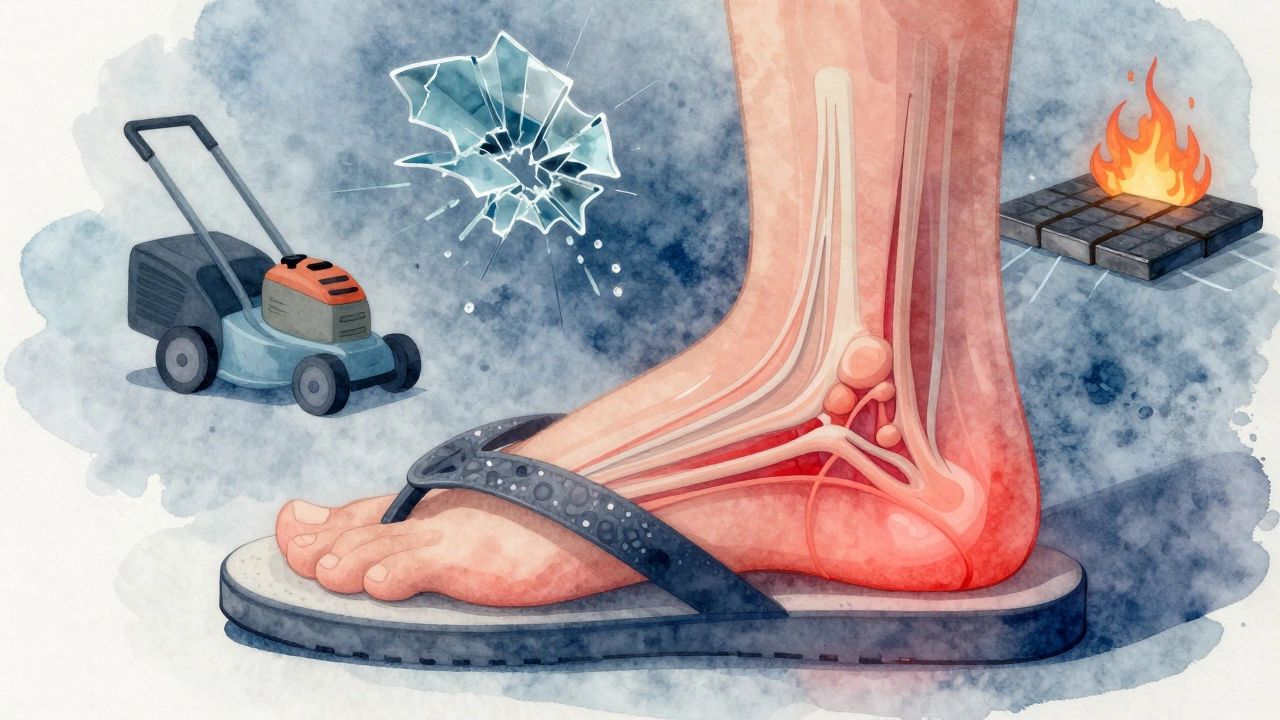
Flip-flops don’t stay on. They slip off. They catch on uneven pavement. They slide into cracks in sidewalks. In 2024, the U.S. Consumer Product Safety Commission reported over 11,000 emergency room visits related to flip-flop injuries-trips, falls, stubbed toes, and even severed toes from lawnmowers. That’s not a small number. It’s more than injuries from high heels.
And it’s not just accidents. The thin soles offer no protection. Step on a sharp rock, a broken bottle, or a hot pavement surface, and your foot takes the hit. No cushioning. No barrier. Just skin and bone. Podiatrists treat burns, cuts, and infections from flip-flops all the time. One patient got a staph infection from a tiny cut she didn’t notice until it spread.
They’re Not Designed for Walking
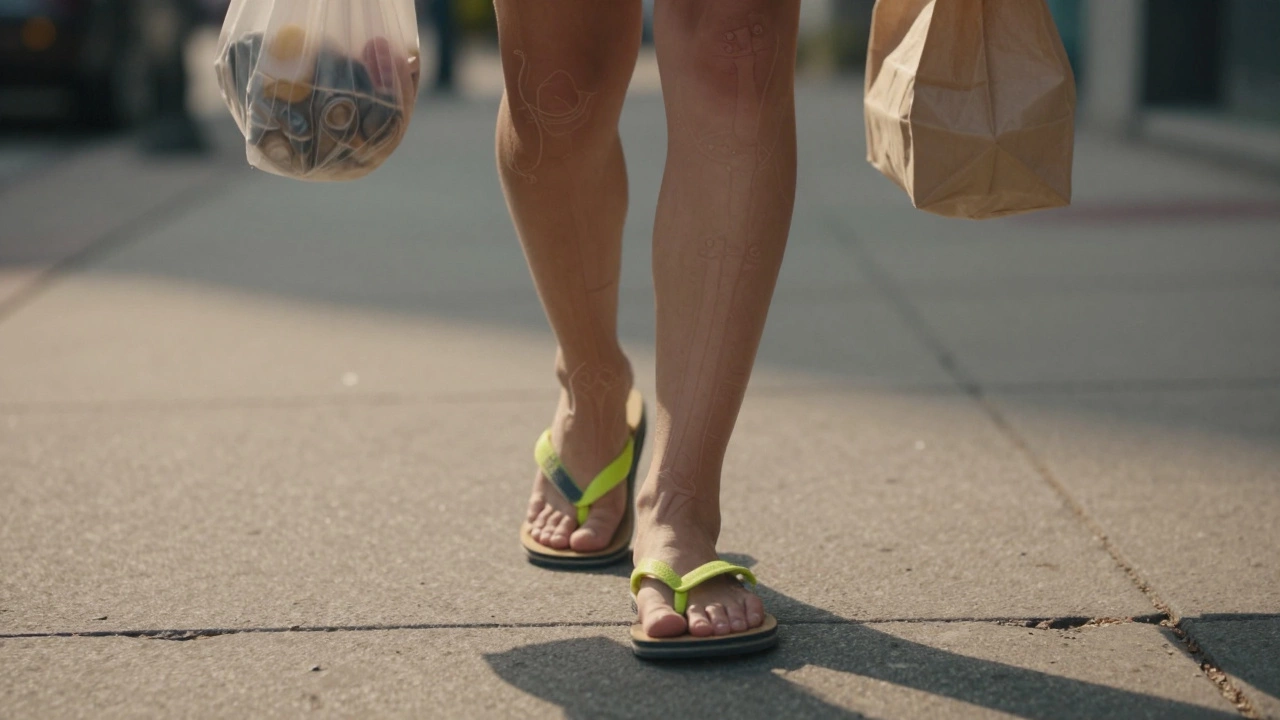
Flip-flops were never meant to be walking shoes. They were designed for the beach, the pool, or a quick trip to the mailbox. But people wear them to the grocery store, to work, to the airport, and on long walks. That’s like wearing socks to hike a mountain. You might make it, but your body will pay for it.
Shoes that support walking have: a firm heel counter, a cushioned midsole, a wide toe box, and a flexible but structured sole. Flip-flops have none of that. They’re essentially a strap and a flat piece of foam. And foam compresses quickly. After a few months, the sole flattens out, and your foot is literally dragging on the ground.
What Podiatrists Recommend Instead
It’s not about giving up comfort. It’s about choosing better. There are plenty of sandals that look like flip-flops but actually support your feet. Look for ones with:
- A contoured footbed with arch support
- A strap that wraps around the heel, not just a thong
- A rubber sole with traction
- A cushioned midsole (not just foam)
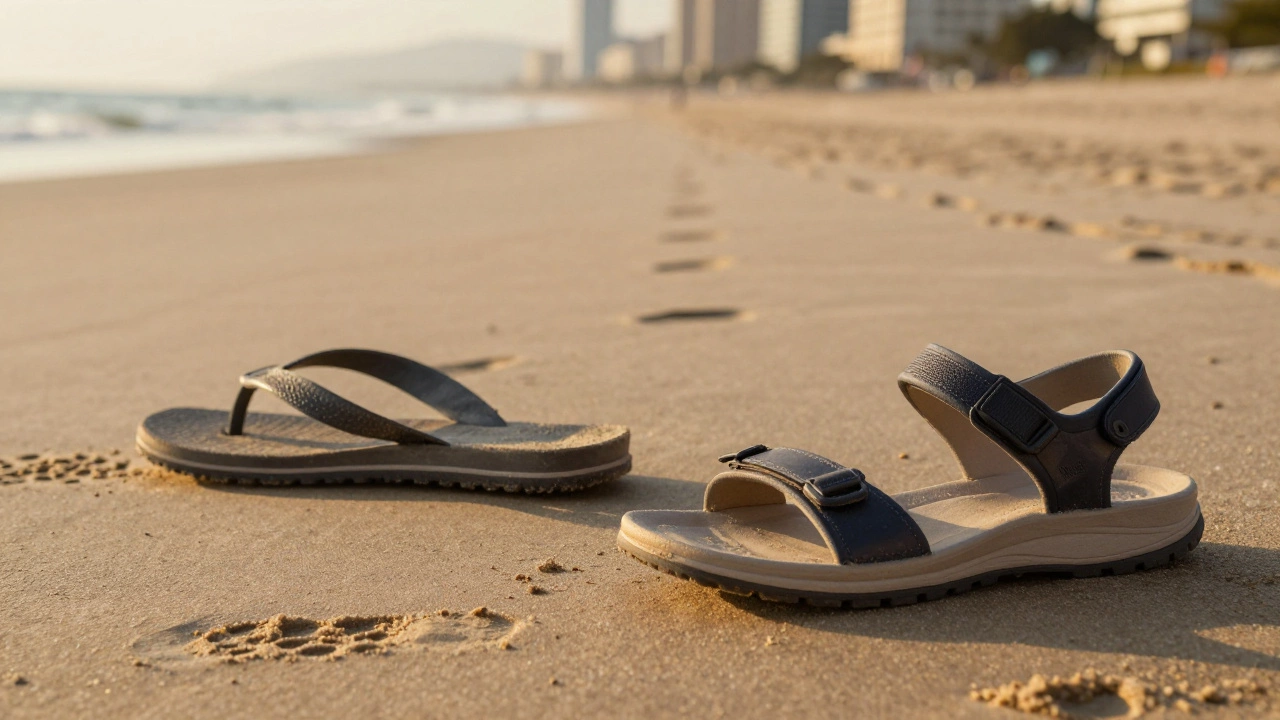
Brands like Vionic, Birkenstock, and Chaco make sandals that look casual but act like supportive footwear. Even some sport sandals from Teva or Merrell have the structure you need. You don’t have to sacrifice style-you just have to upgrade the design.
When Flip-Flops Are Okay
There’s nothing wrong with flip-flops in the right context. Wearing them for 20 minutes at the beach? Fine. Walking from your car to the poolside? Acceptable. But if you’re wearing them for more than an hour a day, especially on hard surfaces, you’re asking for trouble.
Think of it like this: you wouldn’t wear ballet flats to run a marathon. Flip-flops are the ballet flats of the foot world. They’re fine for short, low-impact moments-but not for daily life.
The Real Problem: Normalizing Foot Pain
Most people think foot pain is just part of aging. "My feet hurt, so what?" they say. But that’s the trap. Pain isn’t normal. It’s a signal. Podiatrists see patients who’ve lived with foot pain for years because they didn’t know it was fixable. They thought it was "just how it is."
But it’s not. With the right shoes, orthotics, and stretches, most foot pain caused by flip-flops can be reversed. The problem isn’t the flip-flop itself-it’s the belief that it’s harmless.
What You Can Do Today
If you wear flip-flops often, here’s what to do:
- Track how many hours a day you wear them. If it’s more than one, start cutting back.
- Swap them for supportive sandals when you’re out for errands or walking.
- Stretch your feet daily: roll a tennis ball under your arch for two minutes.
- Check your flip-flops: if the sole is flattened or the strap is stretched, throw them out.
- If you have persistent pain, see a podiatrist before it becomes a chronic issue.
Feet carry you through life. They deserve better than a piece of plastic and a strap. You wouldn’t drive a car with no suspension. Don’t treat your feet like they’re disposable.